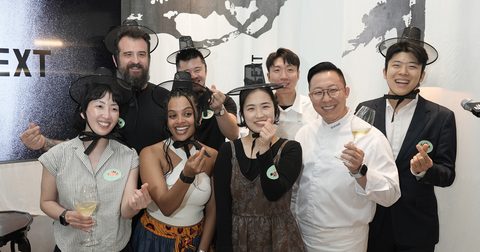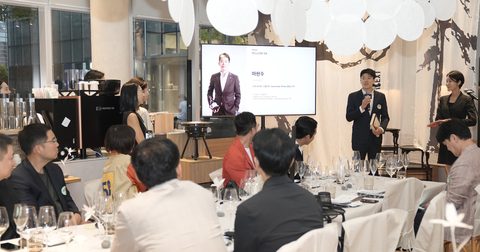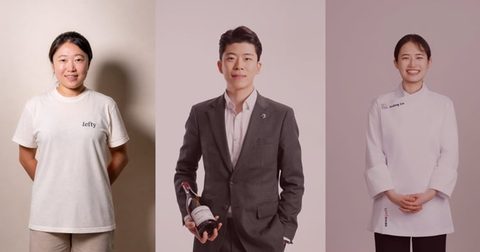
Some one million reservations flood the “world’s No. 1 restaurant,” Noma, every year. In a country of just five million, Noma’s pull is so outsized that Danes call it “Noma Economics.” Chef JungYoon Choi — the leader of a Korean chef-and-industry community — is aiming for the same kind of future for hansik.
By Moon Sang-deok, mosadu@fortunekorea.co.kr · Photography by Kang Tae-hoon
The phrase “globalizing hansik” now feels like a dead expression. Compared with 2010, when it was a headline policy priority, interest today has collapsed to near zero on Google Trends. The government’s pledge to “make hansik one of the world’s top five cuisines” went unfulfilled and drew accusations of wasted tax money.
Chef JungYoon Choi takes a different view. “At least we started then — that is what matters,” she said. Culture, in her view, does not detonate overnight. She was clear, however, about what the government should be doing: “building the industrial groundwork.” A “hansik school” is one such piece of that groundwork. “Spain and Denmark — both now considered culinary powerhouses — began by setting up dedicated institutions for research and education,” she said.
Choi cut her teeth in the global gastronomy game at Spain’s El Bulli, long considered the world’s foremost culinary-science kitchen and the birthplace of the “molecular gastronomy” trend that once swept the food world. In 2010, she brought Spain’s research ecosystem back to Korea as head chef of Sempio’s Woorimat Research Center. In 2022 she formed the Korean-food expert community “Nanrohoe,” which the following year became the nonprofit Nanro Foundation.
Her reason for taking up hansik globalization again, she said, is that “the opportunity has arrived.” Atomix, a Korean restaurant in New York, hit No. 33 on the 2022 World’s 50 Best Restaurants (W50B) list, and that year’s New York Michelin Guide listed nine Korean restaurants. Chefs began saying they wanted to visit Korea. “W50B is a leading indicator for gastronomy trends,” she said. “The current has come.” As Korea-China vice chair of W50B, Choi helped bring the Asia edition of the ceremony to Seoul in March; in April, she is hosting Nanro Insight, a hansik research event with the chefs of the world’s No. 1 and No. 2 restaurants as invited guests.
The hansik brand she believes can rival Japanese sushi is Korean grilled meat — Korean barbecue. “Everyone can grill meat — what’s the big deal?” is the obvious pushback, but the depth and breadth of the Korean barbecue she has been studying goes well beyond common knowledge. On the basis of that research, she has established a private certification for Korean-barbecue specialists — the “Nanro Grill Master.”
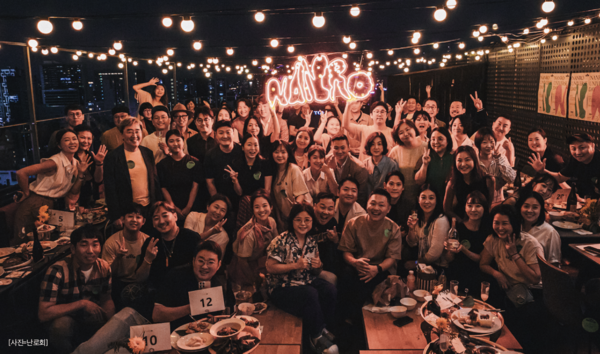
Q. When you said you wanted to train grill specialists, I imagine the response wasn’t all positive. Hotel kitchens themselves are emptying out these days.
Even fine-dining restaurants don’t know meat all that well. They’ve only been trained to grill steak. The cuts used in Western cooking are limited. But we have the saying ildu-baekmi — a single steer offers a hundred tastes. Depending on the cut, some pieces are delicious when grilled in their own fat and others are not. So-galbi grilled in its own fat gets a gamey smell, but chadolbagi (beef brisket) is best when grilled in its own fat.
The grill itself has to change with the cut. For chadolbagi the openings on the grill should be smaller. Even the way the fat drains changes the flavor. From the prototype hansik grill — the jeollip-tugol — onward, our ancestors devised a wide variety of grills. The concave beef-bulgogi pan at the old Seoul restaurant Uraeok is one example. The tilt of the pan, the number and direction of the holes — every element affects taste. Analyzing all this and proving it scientifically is the point of culinary-science research.
Jeollip-tugol: a dish made on a grill shaped like an inverted “jeollip” (a felt hat worn by Joseon-era soldiers), mixing multiple ingredients — the origin of Korean jeongol hot pot. Vegetables blanch in the hollowed center while meat cooks on the raised rim, letting the meat’s juices flow down into the vegetable broth.
Q. Bibimbap and bulgogi are usually seen as the standard-bearers of hansik. Why focus on grilled meat?
Sustainability is the central issue in food culture today. In the West, where meat consumption had run high, there was a strong pivot toward plant-based eating. But sustainability, in my view, cannot lean too far in either direction. The balance can’t break. Hansik has that harmony built in. Korean barbecue is not only meat — it’s roughly half meat and half vegetables. That is the shape of the Korean table itself.
And you know the phrase every Korean grew up hearing at the family table: “Eat everything, in balance.” That is bespoke eating. It’s not about eating one thing — it’s a culture of pairing meat with vegetables. That fits today’s food culture, which prizes self-directed, self-designed dining experiences, very well.
Q. What is the difference between sushi and Korean barbecue?
Sushi began as Japanese street food. But walk into a sushi restaurant today and everything is different, starting with the smell. The lighting is soft. From the moment you enter, a narrative is built. The chef becomes the actor, the sushi bar the stage, the restaurant the theater.
Korean barbecue also needs to build a narrative — beyond taste. We have to brand hansik on the strength of a new Korean-food experience. For example, the practice of showing the raw meat before it hits the grill exists nowhere else — not in any Western steakhouse or grill room. In the kitchen, if you make a mistake on a steak, you can start over. Korean barbecue doesn’t give you that. It’s the difference between film and theater. You have to flip every 10–15 seconds and control the temperature at that moment. It’s a real technique.
Her emphasis on narrative is baked into the name and the operating style of Nanrohoe. Nanrohoe was one of the aristocratic banquet customs of late-Joseon Korea. The Dongguk Sesigi (1849), a chronicle of late-Joseon seasonal customs, records that “on the first day of the tenth lunar month, people would light charcoal in a brazier, place a grate on top, marinate beef in oil-and-soy seasoning and grill it while gathered around — that is what they called Nanrohoe.” The 18th-century writings of Yeonam Ji-won Park and King Jeongjo also mention Nanrohoe. The Joseon painter Danwon Kim Hong-do captured a night-time aristocratic banquet after snowfall in his painting Seolhu Yayeon. “The people who enjoyed Nanrohoe — Yak-yong Jeong, Ji-won Park — were Western-educated thinkers who kept insisting Joseon had to change,” Choi said. “They were the hipsters of their time.”
Just like the old Nanrohoe, Choi invites scholars and artists from across disciplines to her gatherings. During Frieze Seoul last September she invited the painter Park Seo-bo.
The philosophy of story-first cooking is something she brought back from Spain’s culinary-science institute. “I used to think technique was everything to being a good cook,” she recalled. “At the institute, though, I met food-culture scholars, farmers, scientists — even music directors, film directors, architects came by.” “Gastronomy culture is not something chefs build alone,” she said.
Q. What led you to Spain?
In my 30s I started thinking differently. Go to where the best in the world is. El Bulli in Spain — considered the world’s best — and its owner-chef Ferran Adrià, who was the Steve Jobs of the culinary world. I went in 2007, right when he was setting up the Alicia Foundation. The foundation housed a culinary-science research institute. I wanted to know how the global restaurant scene actually operated, and how Spain, of all countries, had climbed to the top of gastronomy. Spain was sweeping the World’s 50 Best list, pushing aside France and Italy, the countries that had exported gastronomy to the world.
Molecular gastronomy — cooking that analyzes the texture, structure and process of food scientifically to create new flavors — is a case in point. It began in France, but the French emphasis on defending traditional technique pushed it to the sidelines. In that gap, Adrià used molecular gastronomy to lift Spanish cooking.
Q. How does a restaurant have the money to run a research lab?
The Spanish government also backed the institute. Because it pays. Take olive oil. Spain, Italy, Turkey, Greece all produce olive oil. But Italy buys olives from Spain and makes Italian olive oil, because it does not grow enough of its own. The same olive turned into oil in Spain sells for 3 euros; turned into oil in Italy, it sells for 7. That made Spain furious. And Spain is not alone: half of Japan’s yuzu products are made from yuzu harvested in Korea.
Denmark ran a similar playbook, investing to become the world’s foremost organic-agriculture country. The organic, seasonal ingredients built by that policy laid the foundation for Noma (which has topped the World’s 50 Best list five times). It used to be a joke to say you were flying to Denmark for the food. How much can there really be to eat on that stark northern land? And yet a million people a year now reserve at Noma — in a country of five million. Hence the term “Noma Economics.”
Q. How did those research outputs actually improve food culture?
The institutes shared their findings with one another at gastronomy events. New theories, new recipes. They took them to the media, too. In the end, the reason Spanish food grew so quickly year after year, I believe, was this shared knowledge. It was the opposite of what I saw as a junior, when senior cooks would hide their recipes. When I first learned to cook in Korea, I never even saw a recipe. Seniors kept them locked in briefcases like classified files and never showed them, because the work was hard and people quit early.
When you go to Spain, you don’t eat only at fine-dining restaurants. You eat paella. You eat tapas (bite-size appetizers well known as Spanish street food). The institute’s goal was to raise the overall quality of Spanish food. My own project there was on deep frying — the fried topping on tapas can’t go soggy. We also created recipes for people who can’t eat wheat because of celiac disease.
Q. You are also Korea-China vice chair of the World’s 50 Best Restaurants.
The Asia ranking was first published in 2012, so this year is the 12th edition. Not a single Korean restaurant made the top 50 in the first year. Chef Park Mu-hyun of Muoki posted online, “Even a Cambodian restaurant made the list — but no Korean restaurant did,” and culinary students commented things like, “I guess Korea just can’t do it.” That made me angry.
The most expensive restaurant in New York right now is a sushi place — $1,300 per person. Sushi restaurants in New York average $500–600. The most expensive Korean restaurant, Atomix, is $380. Once we start branding in earnest, Korean barbecue will spread around the world — and we can’t leave it like this. We have to raise both the price and the status. Let’s talk about that. That is why Nanrohoe was started.
I saw this myself: France earns a great deal as an agricultural country. Its three main crops are wheat, milk and grapes — wheat became bread, milk became cheese, grapes became wine, and out of that agricultural age France built the idea of gastronomy itself. Japanese sake used to be cheap, too. But once the price of sushi rose, the price of sake — the drink paired with sushi — rose with it. If you ask why expensive food is necessary, it is for branding. In the end the industrial volume will be set by the mid- and low-price market. But the overall price level is shaped by national branding. What matters is how much the top pulls up the rest.
Korean barbecue must build a narrative, beyond taste. We have to brand hansik on the strength of a new Korean-food experience.
Q. Nanrohoe’s first public event is coming up.
We invited the chefs of the world’s No. 1 and No. 2 restaurants. I want to show them what’s what. I want to show that hansik can be done this beautifully. We decided to take the results of our Korean-barbecue research to the same stage as these chefs. That is how hansik becomes their equal. The venue mattered too. I wanted to hold the event in a museum or a palace — and thankfully Leeum was willing to lend us the space.
Q. Sticking it out as a female chef in Korea can’t have been easy.
When I first started, people treated me like the neighborhood diner’s auntie. I’d wear an apron branded with a soju logo and blue rubber shoes. Water got in and by nightfall my feet were swollen. And since most of the seniors were male, it wasn’t easy. I cried every day for the first month.
Q. You had other paths besides cooking.
I majored in food and nutrition. When I was applying to university, four-year culinary programs didn’t exist yet. My parents said I needed a four-year degree to get married, so I chose food and nutrition. And yet I still haven’t married. Next time I see my father I should tell him — “still not married!” Though maybe by then I will be. (Laughs.) I think you should do the work you love. So I did — because I wanted to keep learning, and because I wanted to make it better.
· Original (Korean): fortunekorea.co.kr